
Why Use Greywater?
 Reusing greywater - water from sinks, showers, and washing machines but never toilets - is a great way to save water and money. Greywater systems can reduce a household's water use by 10% to 50%, extend the life of a septic system, save time on watering plants, encourage the use of more environmentally friendly products, and use less energy and fewer chemicals than other forms of waste water treatment.
Greywater Codes
In the US, greywater legality varies greatly from state to state. In residential retrofits, many people choose to install systems without permits, regardless of code requirements. For new construction and remodels requiring permits, people usually work with their local building department to obtain a greywater permit, or install a "greywater stubout" to which a future greywater system can be connected after the final inspection. Arizona, Texas, and New Mexico do not require permits for residential greywater, as long as health and safety guidelines are followed. California does not require permits for laundry systems that do not alter the household plumbing, but does require a permit for other types of systems. Some states do not have codes addressing greywater and permits are applied for through an "alternative methods and materials" application. Unfortunately, this can be very costly and time consuming and does not always result in a permit being issued.
To read more about codes and find specific information for your area, ask your local building department or see
- Greywater Action
- Greywater Policy center from Oasis Design
- CA policy center (has a state greywater list-serve)
Greywater Systems
There are three main ways to use greywater.
1. Low tech systems for outdoor irrigation: laundry to landscape and branched drain
2. Medium tech systems for outdoor irrigation: drum effluent pump
3. High tech systems for outdoor irrigation: sand filter to drip
| Laundry to Landscape | Branched Drain |
Drum with |
Sand Filter to Drip |
|
| Pumped | yes | yes | ||
| Needs filtering | yes | |||
| DIY | yes | maybe | maybe | |
| Slab construction | yes | |||
| Needs permit | yes | yes | yes | |
| Works w/ existing irrigation | yes | |||
| Trees and shrubs | yes | yes | yes | yes |
| Large perennials/annuals | yes | yes | yes | |
| Small perennials/annuals | maybe | yes | ||
| Lawn | yes | |||
| Cost | $ | $ | $$ | $$$$ |
1. Low tech greywater systems for outdoor irrigation: landscape direct
Landscape direct greywater systems are the least expensive and the simplest systems to construct. They rely on gravity for distribution and are best for irrigating larger plants such as fruit trees, trees, shrubs, bushes, vines and larger vegetables like corn.
Laundry to landscape: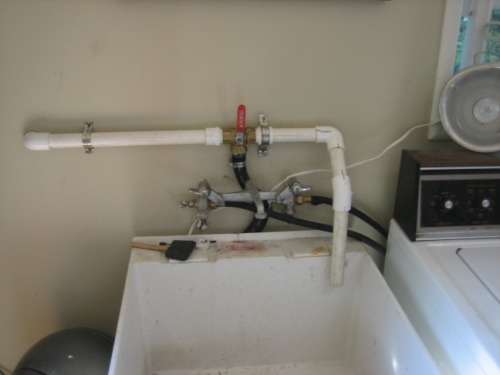
In the Laundry to Landscape Greywater System the washing machine hose is connected to a 3-way valve which allows the homeowner to send the greywater to either the greywater system or sewer/septic systems. Greywater is sent to 1" irrigation tubing which distributes the greywater to multiple outlets in the landscape. This system is low cost, adaptable, and easy to install by a do-it-yourselfer or tradesperson. This type of greywater system was first developed by Art Ludwig of Oasis Design.
Laundry drum:
The wash water is pumped into a "drum," a large barrel or temporary storage container called a surge tank. At the bottom of the drum the water drains out into a hose that is moved around the yard to irrigate. This is a very cheap and easy to install system from the washing machine but requires significant user involvement. Hence, it is most often used by renters or people with large patios that are difficult to cross with pipes.
Branched drain: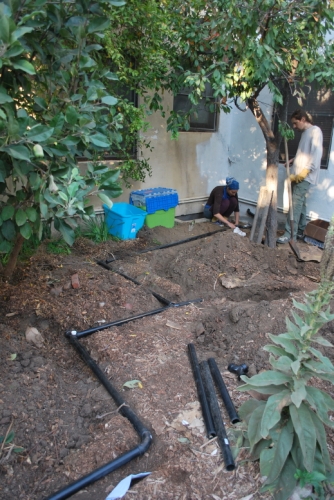
The Branched Drain Greywater System is a gravity-based system that sends greywater from showers, laundry and/or sinks to the landscape using standard (1.5",2") drain pipe. The irrigated area must be lower in elevation than the greywater source. A downward 2% (1/4" per foot) slope must be maintained at all times. The greywater is divided, or "branched" using double ell flow splitters (aka twin 90s), and the final outlet of each "branch" irrigates the root zone of a plant inside a mulch basin. Branched drain systems are best suited for trees or other large shrubs. This kind of system can be time consuming to construct, but once complete requires little maintenance and is long lasting with no moving parts to break. It was first developed by Art Ludwig of Oasis Design.
Follow these guidelines to help ensure the construction of safe and functional low tech systems.
- Never store greywater for longer than 24 hours.
- Install a 3-way valve to divert the greywater to either the greywater system or sewer/septic systems.
- Design the system so human and animal contact is minimized (no open top tanks, no ponds or other standing water).
- Ensure proper infiltration into the ground, no ponding or runoff of greywater (mulch basins are great to use).
- Use plant friendly soaps and products (no salt or boron).
- Keep the system as simple as possible.
- Do not allow greywater to touch the edible portion of any food crop such as root vegetables.
- Never connect the system to the potable water supply (this is called a cross connection and could potentially contaminate the clean water supply).
- Do not use greywater if you live near a stream (50-100 feet) or if the ground water table is within three feet of the greywater discharge.
To learn more about low tech greywater systems see:
- Greywater Action
- Oasis Design
- Book: "Create an Oasis with Greywater" Builders greywater guide
- Video: "Laundry to Landscape"
2. Medium tech systems for outdoor irrigation
Drum with effluent pump:
This system consists of a "drum" or watertight temporary storage container, an effluent pump designed to pump greywater, and distribution tubing in the landscape. The greywater is not filtered so traditional drip emitters or sprayers cannot be used.This system is most often used when irrigation water is required uphill from the greywater source. Although lower in cost than a sand filter to drip system and much simpler to install, the irrigation efficiency is lower.
3. High tech greywater systems for outdoor irrigation
Sand filter to drip
Sand filter greywater systems filter greywater so that it can be used in drip irrigation systems. All the greywater from the house is plumbed to a holding tank where the greywater is stored temporarily. The irrigation controller turns on an effluent pump in the holding tank when an irrigation cycle is needed. The pump sends the greywater through a sand filter where all the hair, lint, and other particles are filtered out. The filtered greywater continues through an open irrigation valve to the drip tubing in the landscape. If no greywater is present the system automatically uses supplemental domestic water to irrigate. The system is fully automated and irrigates more efficiently than any other system. The components are higher in cost and more difficult to install, but allow for great flexibility in irrigation - they can irrigate plants of any size and elevation from the house. Typically, all the accessible household greywater is replumbed and piped into the system.
Follow these guidelines to help ensure the construction of safe and functional drip irrigation systems.
- Filter greywater to 100 microns using a sand filter to keep drip emitters from clogging.
- Install a controller to automatically clean (back flush) the sand filter. Filters which require manual cleaning are prone to user error which can clog the entire drip system.
- If connected to the fresh water supply for supplemental irrigation or back flushing, ensure protection of the water supply by using a reduced pressure back flow preventer or other accepted methods to prevent cross contamination.
- Use plant friendly soaps and products; sand filters only provide mechanical filtration and do not remove salt or other compounds.
- Use an experienced plumber to alter the household plumbing. Accessing all the household greywater can be a complicated plumbing job!
- Don't use greywater if you live near a stream or if the ground water table is within three feet of the greywater discharge
To learn more about high tech greywater systems see
Greywater for indoor use
In theory, greywater can be filtered, disinfected, and pumped back inside the building to be used to flush toilets. In practice, doing so is not easy. For most households, it is easier to use rainwater for toilet flushing and greywater for outdoor irrigation. Composting toilets are a waterless option as well. There are small under the sink units which can be used to flush toilets with bathroom sink water. In practice, these systems still have some kinks that need to be worked out.